What is Claude AI? Features, Uses & Comparison with ChatGPT
The world of artificial intelligence is no longer a one-horse race. For a long time, ChatGPT dominated the conversation — it was the name everyone knew, the tool everyone used, and the benchmark everyone compared against. But a new contender has firmly established itself as a serious alternative, and in many ways, a superior one for certain use cases. That contender is Claude AI.
Developed by Anthropic, Claude AI has rapidly grown from a little-known ChatGPT rival into one of the most powerful, most trusted, and most widely used AI assistants in the world. With a reputation for being safer, more thoughtful, and remarkably human in its responses, Claude has earned its place at the top of the AI conversation.
But what exactly is Claude AI? What can it do? How does it compare to ChatGPT? And most importantly — which one should you be using?
This comprehensive guide answers all of those questions and more. Whether you’re hearing about Claude for the first time or you’re already a user looking to deepen your understanding, you’re in the right place.
What is Claude AI?
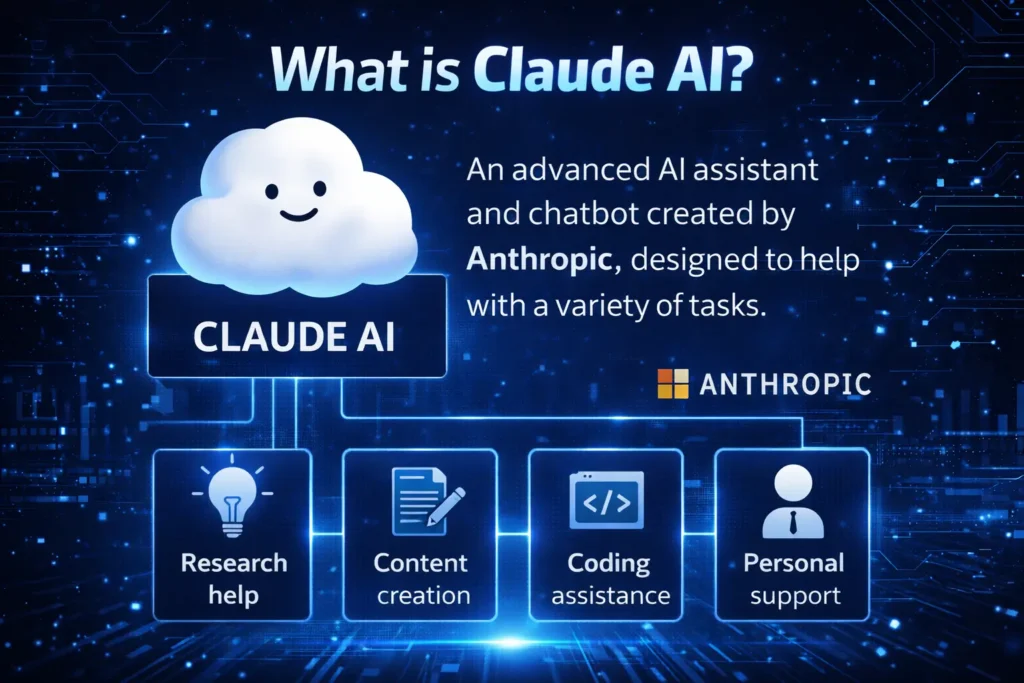
Claude AI is a large language model (LLM) and AI assistant created by Anthropic, an AI safety company founded in 2021 by former OpenAI researchers — including Dario Amodei and Daniela Amodei, who previously held senior roles at OpenAI.
The name “Claude” is believed to be a nod to Claude Shannon, the father of information theory — a fitting tribute for an AI built around the processing and generation of information.
Claude is designed to be a helpful, harmless, and honest AI assistant. Those three words — helpful, harmless, honest — are not just marketing language. They represent Anthropic’s core philosophy in building AI, and they inform every aspect of how Claude behaves, responds, and handles sensitive or complex situations.
At its heart, Claude is a conversational AI — you interact with it through natural language, just like you would with a knowledgeable human assistant. You can ask it questions, give it tasks, have it write content, analyze documents, debug code, brainstorm ideas, and much more.
The Company Behind Claude — Who is Anthropic?
To understand Claude, you need to understand Anthropic.
Anthropic was founded in 2021 with a singular mission: the responsible development and maintenance of advanced AI for the long-term benefit of humanity. The company was born out of a growing concern within the AI research community that safety and ethics were not receiving enough attention in the race to build more powerful models.
Several of Anthropic’s founders, including Dario Amodei (CEO) and Daniela Amodei (President), left OpenAI — the company behind ChatGPT — to start Anthropic with a stronger focus on AI safety research.
The company has since grown into one of the most well-funded and respected AI labs in the world. In February 2026, Anthropic closed a $30 billion funding round at a $380 billion valuation , making it one of the most valuable private technology companies in history. Major investors and partners include Amazon Web Services (AWS) and Google, underscoring just how seriously the tech industry takes Anthropic’s work.
Anthropic developed a safety framework called Constitutional AI (CAI) — a novel approach to training AI models to be safer and more aligned with human values. This framework is central to how Claude thinks, responds, and handles ethically sensitive topics.
Claude AI Models — The Full Family
One of the things that makes Claude especially powerful is that it isn’t a single model — it’s a family of models, each designed for different needs, use cases, and budgets.
Claude Opus — The Most Powerful
Opus is Anthropic’s most capable model, built for deep reasoning, complex long-horizon coding, and agentic workflows. If you need an AI to handle genuinely difficult tasks — digesting dense legal or financial documents, conducting in-depth research, solving complex multi-step problems — Opus is the model for the job. It is the premium tier of the Claude family and is available to paid subscribers.
Claude Sonnet — The Balanced Workhorse
Sonnet models balance cost and intelligence, serving as the default choice for most users. Sonnet is fast, capable, and versatile — making it the ideal model for everyday tasks like writing, coding, analysis, and conversation. The latest iteration, Claude Sonnet 4.6, is the model most users interact with by default and delivers an impressive combination of speed and intelligence.
Claude Haiku — Fast and Efficient
Haiku is the lightest and fastest model in the Claude family. Haiku is ideal for high-volume workloads, real-time applications, and situations where latency and scale matter more than reasoning depth. For developers building applications that need quick, cost-effective AI responses at scale, Haiku is the go-to choice.
This tiered model structure means Claude can serve everyone — from casual individual users to massive enterprises running millions of AI interactions per day.
Key Features of Claude AI
So what exactly can Claude do? The answer is: a lot. Here’s a detailed breakdown of Claude’s standout features.
1. Natural, Human-Like Conversation
Claude is widely praised for how natural and human its responses feel. Unlike some AI models that can feel robotic, formulaic, or overly cautious, Claude engages in conversation with warmth, nuance, and a genuine sense of personality. It listens carefully to what you’re asking, considers the context, and responds in a way that feels genuinely thoughtful rather than mechanically generated.
2. Massive Context Window
One of Claude’s most technically impressive features is its enormous context window. A context window refers to how much text the model can process and “remember” within a single conversation. Pro users enjoy 200,000-token context windows — enough to process entire books, lengthy legal contracts, large codebases, or extensive research documents in a single session. This is a massive advantage for anyone working with large volumes of text.
3. Advanced Writing and Content Creation
Claude is an exceptional writing assistant. It can produce long-form articles, blog posts, essays, reports, marketing copy, social media content, creative fiction, scripts, and more. Its writing style is sophisticated, nuanced, and adaptable — it can match a casual conversational tone just as easily as a formal academic one.
4. Coding and Software Development
Claude is a powerful coding companion. It can write, review, explain, and debug code across a wide range of programming languages including Python, JavaScript, TypeScript, Java, C++, Ruby, Go, and many more. It can also help with database queries, API integrations, architecture decisions, and technical documentation.
5. Document Analysis and Summarization
Upload a PDF, paste in a lengthy article, or share a complex report — Claude can analyze it, summarize it, extract key insights, and answer specific questions about it. This makes it extraordinarily useful for researchers, lawyers, business analysts, students, and anyone who regularly deals with large amounts of written information.
6. Projects Feature
The Projects feature lets you create custom AI projects with uploaded documents, custom instructions, and context retention — essentially giving Claude a persistent memory of your specific work context. This is incredibly useful for ongoing projects where you don’t want to re-explain background information every time you start a new conversation.
7. Safety and Honesty
This is perhaps the most distinctive feature of Claude compared to other AI models. Anthropic has built Claude with a deep commitment to honesty and safety. Claude will tell you when it doesn’t know something rather than making things up. It handles sensitive topics with care and nuance. It declines requests that could cause harm, but does so thoughtfully rather than being overly restrictive. For users who have grown frustrated with AI hallucinations or unhelpful refusals, Claude often strikes a more satisfying balance.
8. Multilingual Support
Claude can communicate effectively in a wide range of languages, making it accessible and useful to a global audience. While its English capabilities are strongest, it performs well across major world languages including Spanish, French, German, Chinese, Japanese, Arabic, and more.
9. Integrations and Connectors
Claude integrates with a growing range of external tools and services. Pro users get connectors for Google Drive, email, and calendar , allowing Claude to work with your existing documents and data in a seamless, connected workflow.
How to Access Claude AI — Plans and Pricing
Claude is available through several access points, each designed for different types of users.
Claude.ai — The Web Interface
The simplest way to use Claude is through claude.ai — a clean, intuitive web interface similar to ChatGPT’s. You can sign up for free and start chatting immediately.
Pricing tiers include:
- Free — Access to Claude’s core capabilities with daily usage limits. Great for casual users and those trying it out.
- Pro — $20 if billed monthly , or around $17/month with an annual subscription. Pro gives you approximately 5x more usage than the free tier, access to more powerful models, the Projects feature, and priority access during peak hours.
- Max — Designed for power users, Max offers either 5× or 20× Pro usage limits depending on your chosen tier. Priced at $100 or $200/month, this is built for heavy all-day workflows.
- Team — $30 per month if billed monthly and $25 if billed annually, with a minimum of 5 members. Includes collaboration features and centralized billing.
- Enterprise — Custom pricing for large organizations, with advanced security, compliance features, SSO integration, and dedicated support.
Claude API
For developers and businesses who want to integrate Claude into their own applications, Anthropic offers direct API access on a pay-per-token basis. This allows companies to build Claude-powered products, chatbots, automation tools, and more.
AWS Bedrock and Google Vertex AI
Claude is also available through Amazon Web Services and Google Cloud, making it easy for enterprise customers to deploy Claude within their existing cloud infrastructure.
What Can You Use Claude AI For?
The practical applications of Claude are vast. Here’s a look at how different types of users are putting it to work:
For Students and Academics
- Getting clear explanations of complex concepts
- Summarizing research papers and textbooks
- Getting feedback on essays and assignments
- Brainstorming ideas for projects
- Preparing for exams through Q&A sessions
For Writers and Content Creators
- Drafting articles, blog posts, and social media content
- Overcoming writer’s block with brainstorming support
- Editing and proofreading existing content
- Adapting content tone and style for different audiences
For Developers and Engineers
- Writing and reviewing code
- Debugging and troubleshooting
- Understanding unfamiliar codebases
- Generating technical documentation
- Exploring architectural decisions
For Business Professionals
- Drafting emails, reports, and presentations
- Analyzing business documents and contracts
- Conducting market research and competitive analysis
- Automating repetitive writing tasks
For Researchers and Analysts
- Processing and summarizing large volumes of text
- Exploring complex topics across multiple domains
- Generating hypotheses and analytical frameworks
Claude AI vs ChatGPT — The Full Comparison
Now for the question most people really want answered: how does Claude compare to ChatGPT?
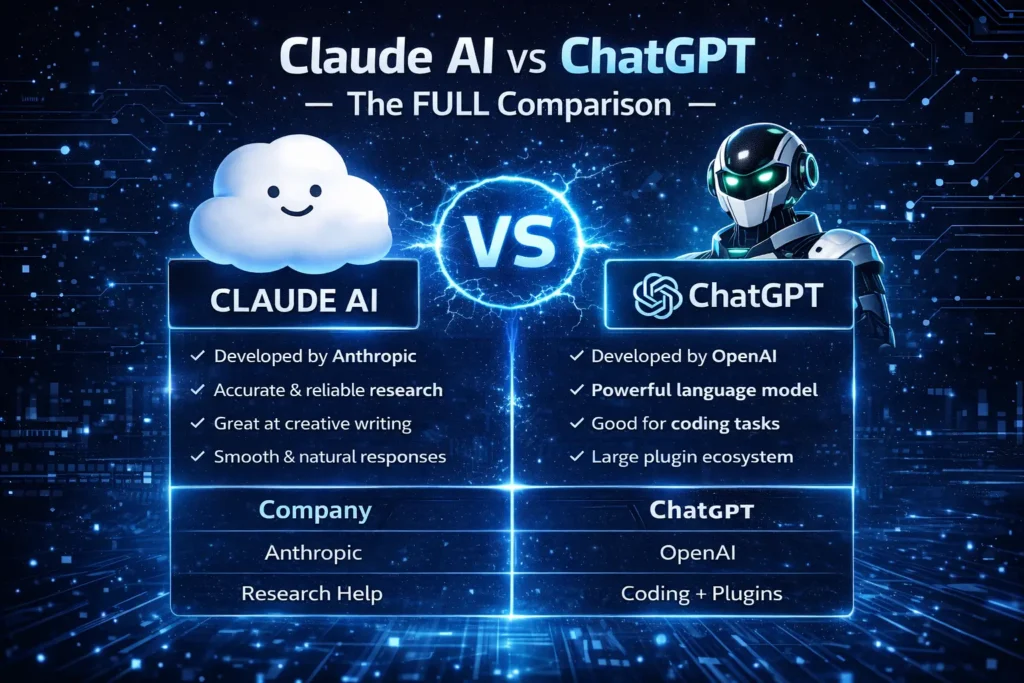
Both are outstanding AI assistants built on large language model technology. Both can handle an enormous range of tasks. But they have distinct strengths, philosophies, and personalities that make each better suited to different users and use cases.
Also read: GPT vs Gemini
Company and Philosophy
ChatGPT is built by OpenAI, a company that started as a non-profit research lab with a mission to ensure AI benefits all of humanity, but has since become a heavily commercialized entity backed by Microsoft’s multi-billion dollar investment.
Claude is built by Anthropic, a company that was founded specifically to prioritize AI safety and is arguably more research-focused and safety-conscious than OpenAI. Anthropic’s Constitutional AI framework represents a more systematic approach to building safe AI than anything OpenAI has publicly released.
Writing Quality
This is often cited as Claude’s strongest advantage. Many users and independent evaluations consistently find that Claude’s writing is more nuanced, natural, and sophisticated than ChatGPT’s. Claude tends to avoid the slightly formulaic, over-structured writing style that ChatGPT can sometimes fall into. For content creators, journalists, and writers, Claude often feels more like collaborating with a skilled human writer.
Reasoning and Analysis
Both models excel at reasoning, but Claude’s larger context window gives it a meaningful edge in tasks that require processing large amounts of information simultaneously. When analyzing lengthy documents, comparing multiple sources, or working on complex multi-step problems, Claude’s ability to hold more context in mind at once is a genuine advantage.
ChatGPT’s GPT-4o model, however, is widely regarded as highly competitive on complex reasoning benchmarks, and the two models trade blows depending on the specific task.
Coding
Both Claude and ChatGPT are excellent coding assistants, and this is genuinely one of the most competitive areas between the two. Claude is particularly strong at explaining code and writing clean, well-documented functions, while ChatGPT’s Code Interpreter feature — which can actually execute code — gives it a unique advantage for certain development tasks.
Image Generation
This is a clear win for ChatGPT. OpenAI’s integration with DALL-E means ChatGPT can generate images directly within the chat interface. Claude currently does not offer native image generation capabilities, which is a meaningful limitation for users who need both text and visual content from a single tool.
Internet Access
ChatGPT has real-time web browsing capabilities built into its interface, allowing it to search the internet and provide up-to-date information. Claude’s base interface does not include real-time web browsing in the same way, though web search capabilities are available in certain contexts and continue to be developed.
Safety and Reliability
Claude is widely regarded as the safer, more reliable model when it comes to avoiding harmful outputs and hallucinations. Anthropic’s Constitutional AI training approach results in a model that is more consistently honest about what it doesn’t know, more careful about sensitive topics, and less prone to producing confidently wrong information.
Pricing
Both Claude and ChatGPT offer free tiers with usage limits. Both offer paid plans at $20/month for their standard Pro/Plus subscriptions, making them directly comparable in price for individual users.
| Feature | Claude AI | ChatGPT |
|---|---|---|
| Developer | Anthropic | OpenAI |
| Free Tier | ✅ Yes | ✅ Yes |
| Paid Plan | $20/month (Pro) | $20/month (Plus) |
| Context Window | Up to 200K tokens | Up to 128K tokens |
| Image Generation | ❌ No | ✅ Yes (DALL-E) |
| Real-time Web Search | Limited | ✅ Yes |
| Writing Quality | ⭐ Excellent | ⭐ Very Good |
| Safety Focus | ⭐ Industry Leading | ⭐ Good |
| Coding | ⭐ Excellent | ⭐ Excellent |
| Document Analysis | ⭐ Excellent | ⭐ Very Good |
Why Claude AI is Growing So Fast
Claude’s rise has been nothing short of remarkable. From a relatively niche alternative to ChatGPT, it has grown into a mainstream AI tool used by millions of individuals and thousands of businesses worldwide.
Several factors are driving this growth:
Trust and Safety — In a world increasingly concerned about AI misinformation, bias, and harmful outputs, Claude’s reputation for being honest, careful, and safe is a powerful differentiator. Organizations — particularly in regulated industries like law, finance, and healthcare — are drawn to Claude’s more cautious approach.
Writing Quality — Word-of-mouth from writers, content creators, and marketing professionals who discovered Claude’s superior writing style has driven significant organic growth.
Large Context Window — For researchers, lawyers, analysts, and developers working with large documents, Claude’s context window capabilities are genuinely transformative.
Enterprise Adoption — Business subscriptions have quadrupled since the start of the year , reflecting strong enterprise demand for Claude’s capabilities in professional settings.
Is Claude AI Right for You?
Here’s a simple way to think about whether Claude is the right AI tool for your needs:
Choose Claude if you:
- Prioritize writing quality and natural conversation
- Work with large documents or need a big context window
- Value safety, honesty, and reduced hallucinations
- Are a professional, researcher, or business user
- Want a thoughtful AI that won’t just tell you what you want to hear
Choose ChatGPT if you:
- Need built-in image generation
- Rely heavily on real-time web search
- Want access to the broadest ecosystem of third-party plugins
- Are already deeply integrated into the OpenAI ecosystem
The good news? You don’t have to choose just one. Both tools offer free tiers, and many power users keep both in their arsenal — using Claude for writing and document analysis, and ChatGPT for image generation and web research.
Final Thoughts
Claude AI is not just another ChatGPT clone. It is a genuinely distinct, thoughtfully built AI assistant with its own philosophy, strengths, and personality. Backed by one of the most respected AI safety organizations in the world, built on cutting-edge technology, and trusted by millions of users across the globe, Claude represents the best of what modern AI can be when safety and capability are developed hand in hand.
Whether you’re a student, a professional, a developer, or simply a curious person wanting to explore the possibilities of AI — Claude is absolutely worth trying. And once you do, there’s a good chance you’ll understand exactly why so many people have made it their AI assistant of choice.
The future of AI is not a single model or a single company. It’s a rich, competitive ecosystem of tools — and Claude AI is firmly, confidently, at the top of that ecosystem.
Ready to try Claude AI for yourself? Head over to claude.ai and start your first conversation — it’s free to get started.