ChatGPT 3.5 – The Complete Guide to OpenAI’s Most Accessible AI Chatbot
Artificial intelligence has gone from a concept confined to science fiction to something billions of people interact with on a daily basis. And at the center of this revolution sits one name that almost everyone has heard by now — ChatGPT. Specifically, ChatGPT 3.5 played a monumental role in bringing AI to the mainstream, making it one of the most talked-about technological breakthroughs of the modern era.
Whether you’re a student trying to get homework help, a business owner looking to automate tasks, a developer exploring AI capabilities, or just a curious person who wants to understand what all the fuss is about — this guide is for you. We’re going to cover everything there is to know about ChatGPT 3.5: what it is, how it works, what it can do, its limitations, how it compares to newer models, and why it still matters today.
Let’s dive in.
What Is ChatGPT 3.5?
ChatGPT 3.5 is an AI-powered conversational chatbot developed by OpenAI, built on top of the GPT-3.5 language model. It was officially launched to the public in November 2022 and took the world by storm almost overnight, reaching one million users within just five days of its release — a milestone that took platforms like Netflix years to achieve.
But what exactly is it?
At its core, ChatGPT 3.5 is a large language model (LLM) — a type of artificial intelligence trained on massive amounts of text data from the internet, books, articles, and other written sources. Through this training, the model learned to understand human language and generate coherent, contextually relevant responses to a wide variety of questions and prompts.
The “Chat” in ChatGPT refers to its conversational interface — unlike traditional search engines that return a list of links, ChatGPT responds in natural, flowing language, much like a human would in a conversation.
GPT stands for Generative Pre-trained Transformer — which describes the underlying architecture of the model. “Generative” means it creates new text, “Pre-trained” means it was trained on a large dataset before being fine-tuned, and “Transformer” refers to the neural network architecture that powers it.
The Technology Behind ChatGPT 3.5
To appreciate what ChatGPT 3.5 can do, it helps to understand a little about how it works under the hood — don’t worry, we’ll keep it accessible.
GPT-3.5 Architecture
ChatGPT 3.5 is built on the GPT-3.5 Turbo model, which is an improved and more efficient version of the original GPT-3 model released in 2020. GPT-3 itself was a landmark achievement — a model with 175 billion parameters that demonstrated an unprecedented ability to understand and generate human-like text.
Parameters are essentially the “settings” or “weights” within a neural network that the model adjusts during training to get better at predicting the next word in a sequence. More parameters generally mean a more capable model, though efficiency and fine-tuning matter just as much as raw size.
Reinforcement Learning from Human Feedback (RLHF)
One of the key reasons ChatGPT 3.5 feels so natural to talk to — compared to earlier AI chatbots — is a training technique called Reinforcement Learning from Human Feedback (RLHF). Here’s how it works in simple terms:
- The base GPT-3.5 model generates responses to various prompts.
- Human trainers rank or rate those responses based on quality, helpfulness, and safety.
- The model is then fine-tuned using those human preferences, learning to produce responses that humans find more useful and appropriate.
This process is what separates ChatGPT from a raw language model — it’s been specifically optimized to be a helpful, conversational assistant rather than just a text predictor.
Transformer Neural Networks
The “Transformer” architecture, introduced by Google researchers in a landmark 2017 paper titled “Attention Is All You Need,” is the backbone of ChatGPT 3.5. Transformers use a mechanism called self-attention that allows the model to weigh the importance of different words in a sentence relative to each other — enabling it to understand context much more effectively than previous architectures.
Key Features of ChatGPT 3.5
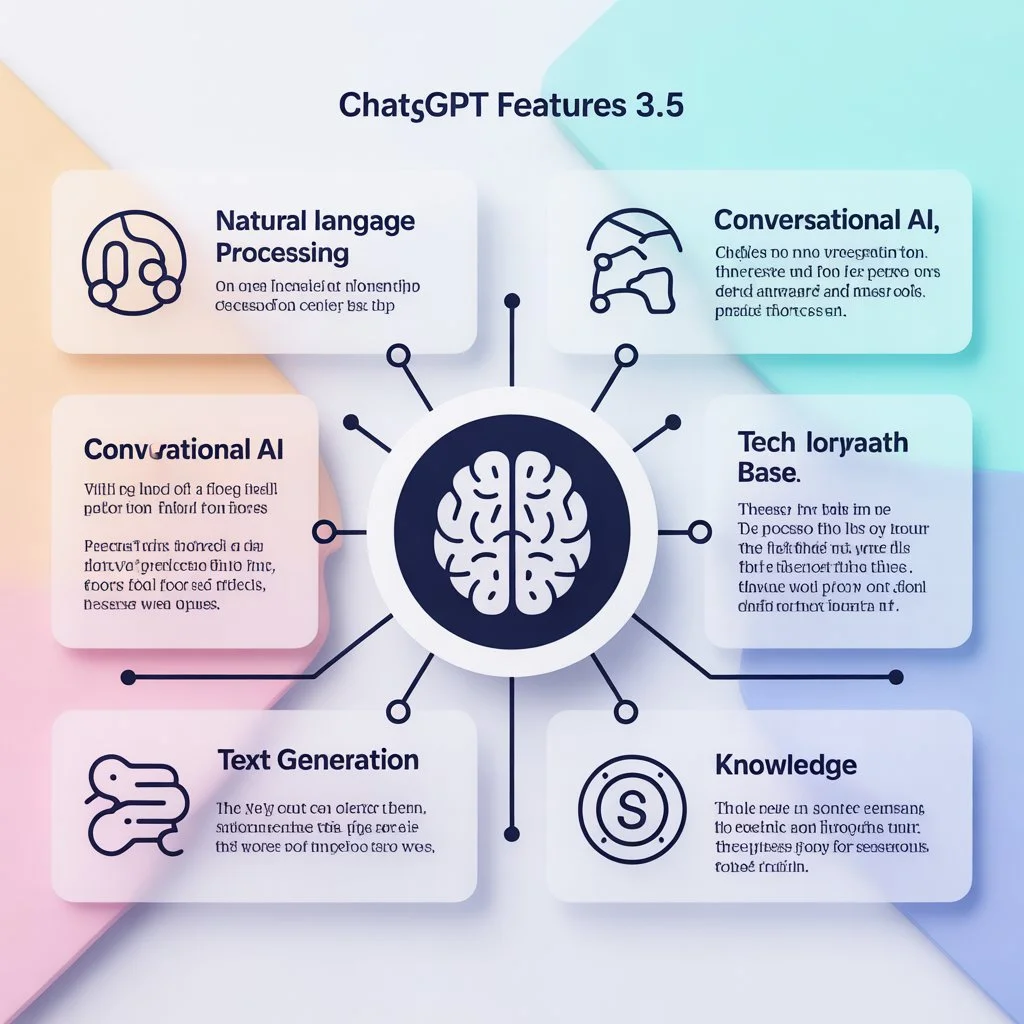
So what can ChatGPT 3.5 actually do? Quite a lot, as it turns out.
1. Natural Language Conversation
The most obvious feature is its ability to hold a natural, flowing conversation on virtually any topic. You can ask it questions, request explanations, debate ideas, or simply chat — and it responds in a way that feels remarkably human.
2. Content Writing and Editing
ChatGPT 3.5 is a powerful writing assistant. It can draft blog posts, essays, emails, social media captions, product descriptions, cover letters, and much more. It can also edit and improve existing writing for tone, clarity, grammar, and style.
3. Code Generation and Debugging
Developers quickly discovered that ChatGPT 3.5 is exceptionally good at writing code. It supports dozens of programming languages including Python, JavaScript, HTML, CSS, Java, and more. It can write functions from scratch, explain what a piece of code does, identify bugs, and suggest fixes.
4. Summarization
Feed ChatGPT 3.5 a long article, research paper, or document, and it can produce a concise, accurate summary in seconds. This is incredibly useful for students, researchers, and professionals who need to process large amounts of information quickly.
5. Translation
While not as specialized as dedicated translation tools, ChatGPT 3.5 can translate text between a wide range of languages with reasonable accuracy, making it useful for quick translations or understanding foreign-language content.
6. Question Answering and Research Assistance
Need to understand a complex topic quickly? ChatGPT 3.5 can break down difficult concepts — from quantum physics to tax law — into plain, understandable language. It’s like having a knowledgeable friend available 24/7.
7. Brainstorming and Ideation
Stuck for ideas? ChatGPT 3.5 is an excellent brainstorming partner. Whether you need business name ideas, plot twists for your novel, marketing campaign concepts, or gift ideas — it can generate a wide variety of creative suggestions rapidly.
8. Math and Problem Solving
While not infallible, ChatGPT 3.5 can handle a wide range of mathematical problems, from basic arithmetic to algebra, calculus, and statistics. It can also walk you through the steps of solving a problem, making it a useful study tool.
What Makes ChatGPT 3.5 Different from Other AI Tools?
Before ChatGPT 3.5 arrived, most people’s experience with AI chatbots was fairly underwhelming — rigid, scripted, and frustratingly limited. So what made ChatGPT 3.5 different?
Contextual Understanding
Earlier chatbots could answer specific, narrow questions but fell apart when conversations became complex or multi-layered. ChatGPT 3.5 maintains context throughout a conversation — it remembers what was said earlier in the same chat session and builds upon it, making interactions feel coherent and natural.
Breadth of Knowledge
Trained on a vast and diverse dataset, ChatGPT 3.5 has a working knowledge of an enormous range of subjects — science, history, literature, technology, medicine, law, cooking, sports, philosophy, and much more. This breadth makes it genuinely useful across countless use cases.
Accessibility
Perhaps most importantly, OpenAI made ChatGPT 3.5 free to use through a simple web interface at chat.openai.com. No technical knowledge required, no complex setup — just visit the website, type your question, and get an answer. This accessibility is a huge reason for its explosive adoption.
Limitations of ChatGPT 3.5
For all its impressive capabilities, ChatGPT 3.5 is not without its limitations. Being aware of these is crucial for using it effectively and responsibly.
Knowledge Cutoff
ChatGPT 3.5 has a training data cutoff, meaning it doesn’t have knowledge of events that occurred after a certain date. This means it can’t tell you about recent news, newly released products, or current events beyond its training window.
Hallucinations
One of the most widely discussed issues with ChatGPT 3.5 is its tendency to “hallucinate” — that is, confidently produce information that sounds plausible but is factually incorrect. It might cite a study that doesn’t exist, get a historical date wrong, or invent a quote from a real person. This makes fact-checking essential whenever you use it for research.
No Real-Time Internet Access
Unlike a search engine, the base version of ChatGPT 3.5 cannot browse the internet in real time. It works entirely from its training data, which means it can’t pull up live information, current prices, or breaking news.
Bias
Because it was trained on internet data — which reflects human society in all its complexity — ChatGPT 3.5 can sometimes reflect biases present in that data. OpenAI has worked to mitigate this, but it remains an ongoing challenge for all large language models.
Lack of True Understanding
At a fundamental level, ChatGPT 3.5 doesn’t truly “understand” anything the way humans do. It predicts the most statistically likely next word or sentence based on patterns in its training data. This means it can sometimes give technically correct but contextually inappropriate answers, or miss subtle nuances in complex situations.
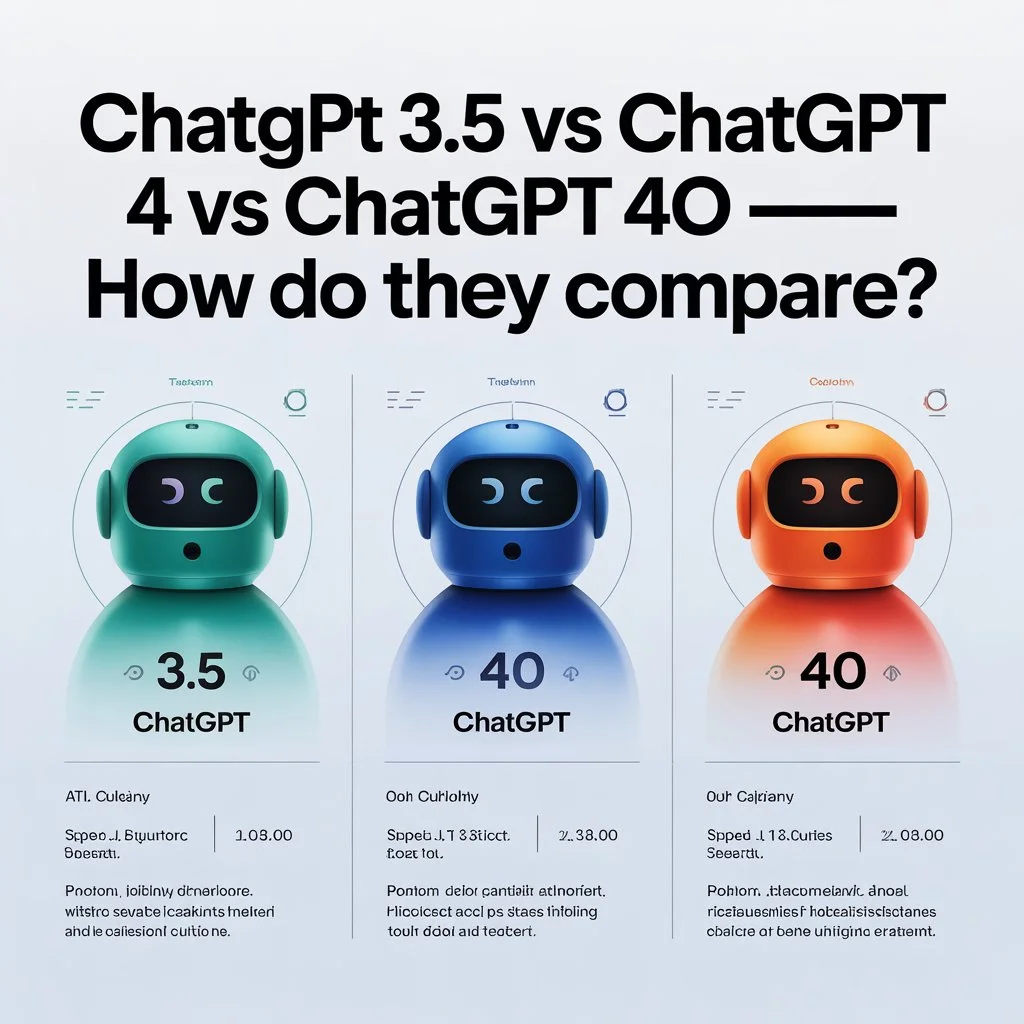
ChatGPT 3.5 vs ChatGPT 4 vs ChatGPT 4o — How Do They Compare?
Since ChatGPT 3.5 launched, OpenAI has released significantly more advanced models. Here’s how they stack up:
ChatGPT 3.5
- Free to use
- Fast response times
- Excellent for everyday tasks — writing, coding, Q&A
- Limited reasoning ability on highly complex problems
- No image understanding
ChatGPT 4
- Available via ChatGPT Plus (paid subscription)
- Significantly improved reasoning and accuracy
- Better at complex, multi-step problems
- More reliable, fewer hallucinations
- Multimodal — can understand and analyze images
ChatGPT 4o (“omni”)
- OpenAI’s most advanced model at the time of writing
- Faster than GPT-4 with comparable or better performance
- Voice, image, and text capabilities in a unified model
- Available to both free and paid users (with usage limits)
- More natural, human-like conversational style
For most everyday users, ChatGPT 3.5 remains a highly capable and completely free option that handles the vast majority of common tasks with ease. The newer models shine in specialized, high-complexity scenarios.
Who Uses ChatGPT 3.5 and How?
The beauty of ChatGPT 3.5 is its versatility. Here’s a look at how different groups are putting it to work:
Students and Educators
Students use it to understand difficult concepts, get essay feedback, generate study materials, and work through math problems. Teachers use it to create lesson plans, quizzes, and educational content.
Writers and Content Creators
Bloggers, journalists, copywriters, and authors use ChatGPT 3.5 to overcome writer’s block, generate drafts, brainstorm ideas, and edit their work. It has become an indispensable tool in the content creation industry.
Developers and Programmers
From writing boilerplate code to debugging complex functions, developers across all skill levels use ChatGPT 3.5 to speed up their workflow and learn new programming concepts.
Business Owners and Entrepreneurs
Small business owners use it to draft marketing copy, respond to customer queries, create business plans, and handle administrative writing tasks — essentially getting the productivity of a full-time assistant at zero cost.
Researchers and Analysts
While always subject to verification, ChatGPT 3.5 helps researchers quickly synthesize information, understand unfamiliar fields, and generate hypotheses or frameworks for further exploration.
Is ChatGPT 3.5 Still Worth Using in 2026?
With newer, more powerful models available, you might wonder — is ChatGPT 3.5 still relevant?
The answer is a resounding yes, for several reasons:
- It’s free — for users who don’t want to pay for a subscription, ChatGPT 3.5 delivers exceptional value at no cost.
- It’s fast — GPT-3.5 Turbo is one of the fastest models OpenAI offers, making it ideal for quick tasks.
- It handles most tasks perfectly well — for the majority of everyday use cases, ChatGPT 3.5 is more than capable.
- It’s widely integrated — many third-party apps, plugins, and tools are built on the GPT-3.5 API, meaning you’re likely using it even without knowing it.
For power users who need cutting-edge reasoning or multimodal capabilities, upgrading to GPT-4o makes sense. But for millions of everyday users, ChatGPT 3.5 remains a reliable, powerful, and completely accessible AI companion.
How to Get Started with ChatGPT 3.5
Getting started with ChatGPT 3.5 is incredibly simple:
- Visit chat.openai.com
- Create a free account using your email or Google/Microsoft login
- Start a new conversation and type your first prompt
- Explore — ask questions, request writing help, try coding tasks, or just have a conversation
There’s no learning curve. The interface is clean, intuitive, and beginner-friendly. Within minutes of signing up, you’ll be having productive conversations with one of the most powerful AI systems ever built.
Final Thoughts
ChatGPT 3.5 is not just a chatbot — it’s a landmark in human technological achievement. It democratized access to powerful AI, putting a capable and knowledgeable assistant in the hands of anyone with an internet connection, completely free of charge.
From students to CEOs, from hobbyists to hardcore developers, ChatGPT 3.5 has found a place in the workflows and daily lives of hundreds of millions of people worldwide. Its limitations are real, but so is its transformative potential.
As AI continues to evolve at a breathtaking pace, ChatGPT 3.5 will be remembered as the model that started it all for the general public — the one that made artificial intelligence feel not just powerful, but genuinely useful, approachable, and human.
Whether you’re using it for the first time or the thousandth, there’s always something new to discover with ChatGPT 3.5. And that, perhaps, is its greatest achievement of all.
Enjoyed this article? Share it with someone who’s just getting started with AI — they’ll thank you for it.